
Last week, Mombasa became the first African city to host the 11th Our Ocean Conference, marking historic first for the continent. Held under the theme “Our Ocean, Our Heritage, Our Future,” the conference brought together governments, scientists, Indigenous leaders, youth, women leaders, civil society, private sector actors and development partners to accelerate ocean action at a time when marine ecosystems, coastal communities and blue economy sectors are facing growing pressure from climate change, pollution, biodiversity loss and unsustainable resource use.
OOC11 core action areas
The conference focused on six core action areas:
- Marine Protected Areas
- Sustainable Fisheries
- Marine Pollution
- Sustainable Blue Economy
- Ocean-Climate Nexus
- Maritime Security
These priorities speak directly to the future of coastal communities, ocean-dependent livelihoods, maritime systems, food security, and sustainable development across Africa and the world.
Key Messages at OOC11
- Science must be packaged in ways that inform policy, planning and investment decisions.
- Ocean priorities need to be better integrated into NDCs, finance reforms, and national development strategies.
- Local communities, Indigenous Peoples, women and youth are not only beneficiaries of ocean action; they are central actors in designing and delivering solutions.
- Ocean finance must move closer to implementation, especially for community-led action, coastal resilience, and sustainable livelihoods.
- The future of Africa’s blue economy must be evidence-based, inclusive, and investment-ready.
The AGNES at OOC11
For AGNES, represented by Fred Kung’u and Telvin Denje, the conference provided an important platform to follow and contribute to discussions on the ocean-climate nexus, particularly on how science, policy, finance and local leadership can be better aligned to deliver practical action for Africa’s ocean future.
“This conference is about turning words into commitments, commitments into action, and action into a legacy we can be proud of,” said Hassan Ali Joho, Kenya’s Cabinet Secretary for Mining and Blue Economy.
The conference focused dialogue, delivery, accountability, and implementation.
Ocean-Climate Action at the centre
AGNES closely followed the ocean-climate discussions, recognizing that a sustainable blue economy cannot be achieved without addressing climate risks to fisheries, coral ecosystems, mangroves, seagrasses, coastal livelihoods, ports and maritime systems. Ocean-based action, including the protection of blue carbon ecosystems, sustainable fisheries, resilient coastal infrastructure, clean maritime transport and ocean-climate finance, must be effectively integrated into national climate and development planning.
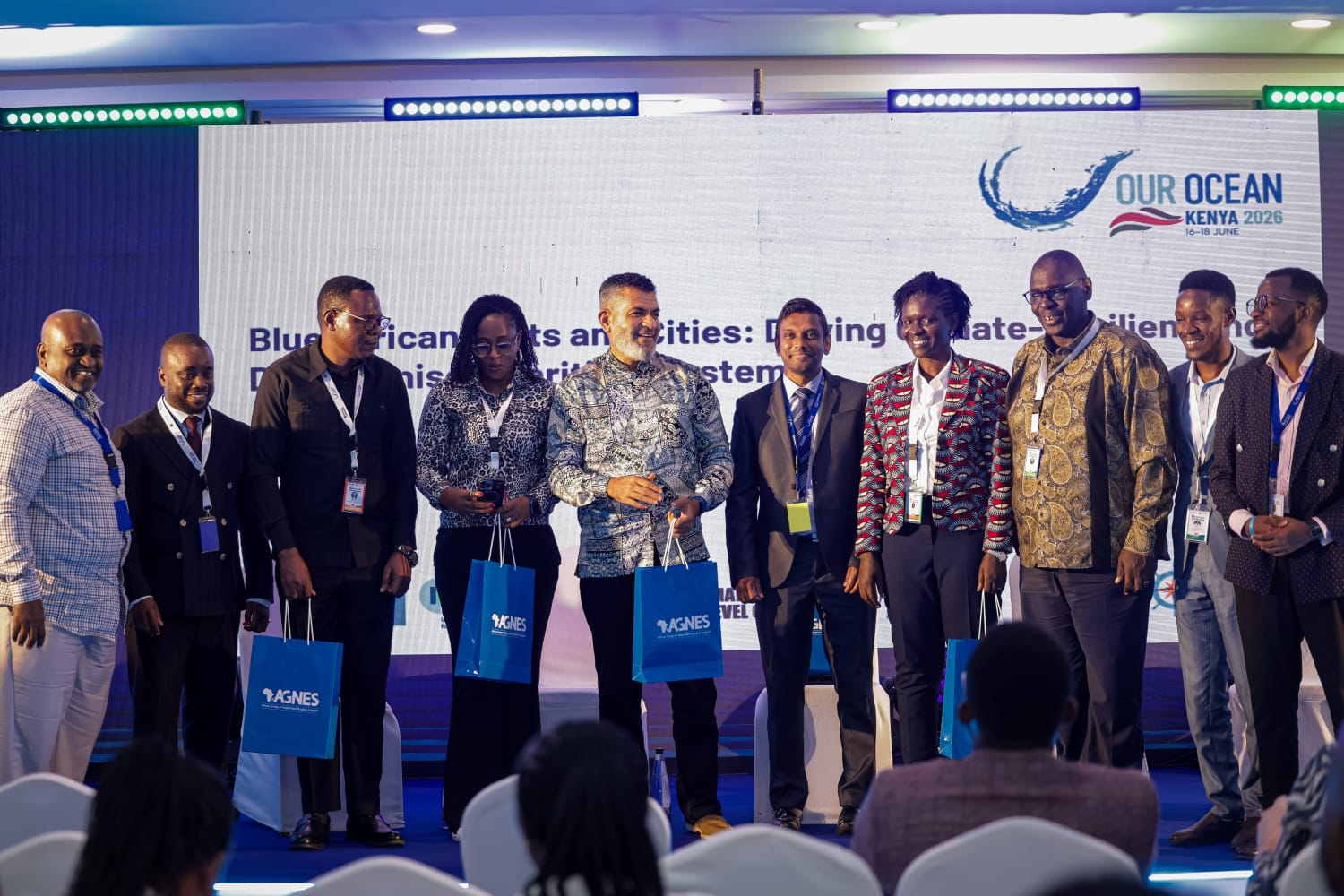
OOC11 Side Event: Blue African Ports and Cities: Driving Climate-Resilient and Decarbonised Maritime Systems.
As part of the conference, AGNES, together with C40 Cities, co-hosted the side event Blue African Ports and Cities: Driving Climate-Resilient and Decarbonised Maritime Systems. The session brought together governors, mayors, port actors, policymakers, industry players, academia and technical partners to examine how African ports and cities can move from climate ambition to implementation.
Ports are critical to Africa’s blue economy. They move goods, connect countries to regional and global markets, support jobs and anchor coastal economies. But they are also exposed to climate risks such as flooding, sea-level rise, coastal erosion, extreme heat and storm surges. These risks affect not only port infrastructure, but also workers, nearby communities, transport corridors, drainage systems, ecosystems, and local economies.
The side event focused on how ports and cities can work together to address these risks while also advancing maritime decarbonization. The keynote remarks from the Governor of Mombasa highlighted the importance of collaboration between the port and county government in environmental management, while also pointing to opportunities for deeper cooperation around resilience, coastal protection and sustainable urban development.
The panel discussion, moderated by the Kenya Maritime Authority, explored one central question: how can ports and cities mobilize finance and partnerships to move from plans to delivery? Speakers reflected on what works, what does not, and what is needed to strengthen port-city collaboration. The discussion highlighted the importance of:
- Using climate risk assessments to inform real decisions and investments.
- Strengthening coordination between port authorities, cities, counties, national governments, and communities.
- Moving from assessment to implementation through costed and prioritized investment pipelines.
- Addressing practical risks such as flooding, coastal erosion, waste, drainage and stormwater management.
- Supporting maritime decarbonization through cleaner transport systems, green port infrastructure, and low-emission technologies.
- Mobilising public-private partnerships and targeted finance for resilience actions.
Lessons from the Port of Mombasa climate risk screening showed how evidence can help identify priority risks and shape practical responses. Discussions pointed to actions such as addressing coastal erosion, improving drainage systems, developing integrated stormwater management, and allocating resources to address identified resilience gaps.
The session concluded with a call to action from partners, including the City of eThekwini, Lloyd’s Register Foundation, Ocean Centres Kenya and ICLEI, with emphasis on technical support, finance, partnerships and stronger implementation pathways for port resilience across Africa and the Global South.
Beyond the Side Event
Beyond the side event, AGNES participated in and followed several strategic sessions, including those on Indigenous leadership at the frontline of the ocean-climate nexus, unlocking maritime transport investment for the blue economy, the launch of the Africa marine carbon dioxide removal roadmap, scaling ocean-climate action at COP30, and advancing Africa’s blue economy from strategic frameworks to implementation.
Call to Action: From Commitments to Delivery
As OOC11 concluded, the central message was clear: the success of ocean action will not be measured by commitments alone, but by how quickly they are translated into measurable benefits for people, ecosystems and economies. For Africa, this means moving with urgency to turn ocean-climate priorities into implementation. Countries must strengthen the integration of ocean priorities in NDCs, NAPs, blue economy strategies, and finance plans. Science must be packaged in ways that inform policy and investment decisions. Finance must reach the communities, institutions, and sectors that are already working on the frontlines of ocean and climate change.