
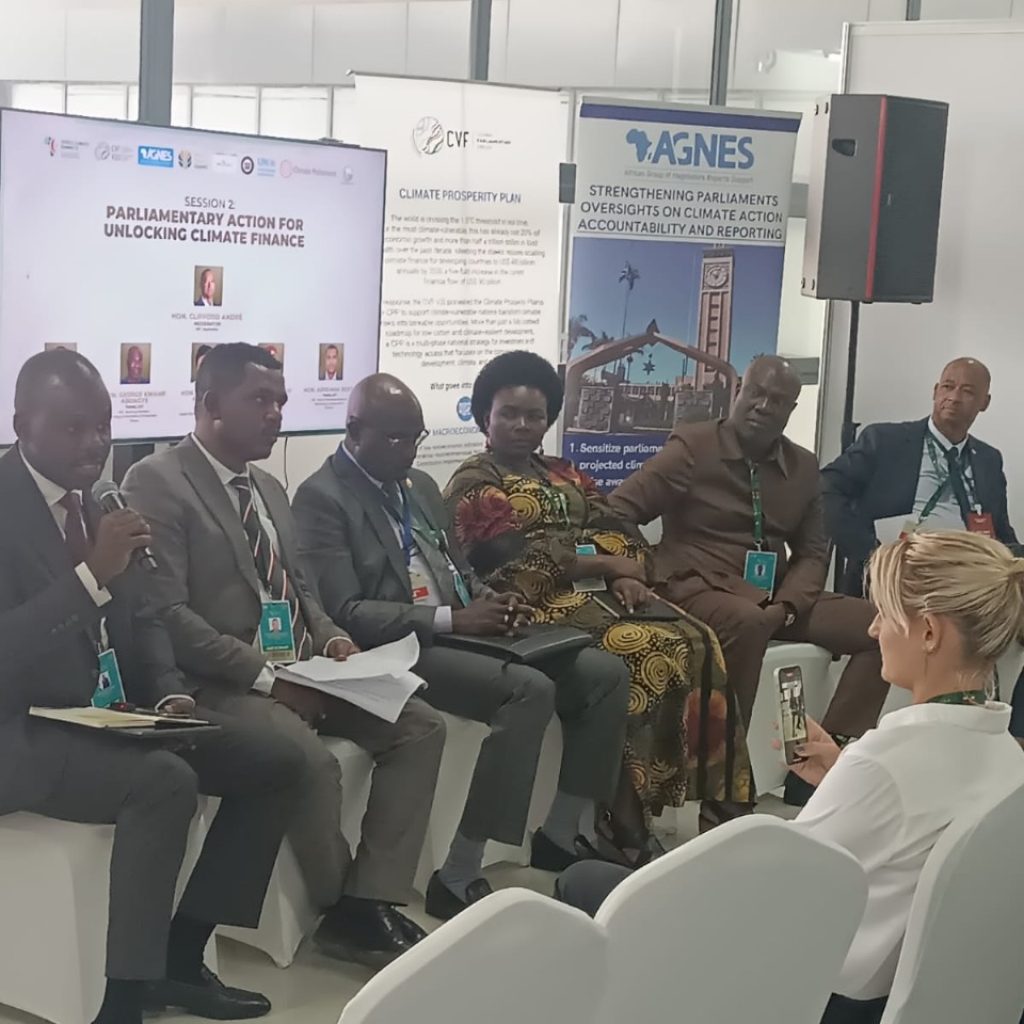
At the Second Africa Climate Summit (ACS2) in Addis Ababa, Ethiopia, African legislators convened for a Parliamentary Dialogue on “Financing for Africa’s Resilient and Green Development: Parliamentary Pathways.” The Africa Network of Parliamentarians on Climate Change (ANPCC) participated alongside colleagues from national and regional parliaments, creating space for shared learning, collective strategizing, and stronger parliamentary engagement in Africa’s climate response.
Parliamentarians Claim Their Space in Climate Leadership
Since the inaugural Africa Climate Summit in 2023, African parliamentarians have steadily expanded their role in continental climate governance. The adoption of the Abidjan Declaration, 2024 which established the ANPCC, marked a turning point. At ACS2, this momentum was reinforced through the Parliamentary Dialogue, co-hosted by ANPCC, AGNES, and partners including Climate Parliament, CVF-V20, the Parliament of Kenya, the Ethiopian House of Peoples’ Representatives, World Future Council and UNEP. Discussions focused on how parliaments can unlock climate finance, use tools to enhance their parliamentary roles, accelerate clean energy transitions, and support nature-based solutions. Speakers at the dialogue highlighted the importance of Parliaments working hand-in-hand with the Executive to turn climate commitments into tangible results for communities.
Tools for Action: From Model Laws to Accountability
Also, the dialogue offered African parliamentarians a chance to explore decision support tools that strengthen legislative oversight and policy development. The Model Climate Change Law Framework for Africa and the Climate Monitoring and Accountability Tool (CMAT) were spotlighted as innovations designed to guide countries in enacting effective laws and tracking implementation. These tools are equipping legislators to push for inclusive, accountable, and impactful climate governance.
From Chad to Uganda, Kenya to Seychelles, and across to Ethiopia and Ghana, parliamentarians used the Dialogue to demonstrate how African legislatures are moving from words to action, championing model laws, enacting domestic climate laws, pioneering finance initiatives, and strengthening oversight to ensure climate resources reach the people who need them most.
A Continental Call to Action
The Parliamentary Dialogue culminated in a joint communiqué, endorsed by representatives from 20 African parliaments. The communiqué called on governments and international partners to:
- Mainstream climate resilience into national planning and budgets.
- Enact and strengthen robust climate change laws, aligned with Africa’s model framework.
- Increase domestic budget allocations for climate action.
- Scale up climate finance commitments to Africa and make them accessible, predictable, and equitable.
- Empower parliamentarians to lead through legislation, oversight, and constituency engagement.
This unified message reinforced African MPs’ readiness to drive climate ambition from the legislative frontlines.
Looking Ahead
The ANPCC’s presence at ACS2 demonstrated how parliaments can shape Africa’s climate future, from showcasing legislative tools such as the Model Climate Change Law and CMAT, to rallying 20 parliaments behind a joint communiqué that called for stronger laws, predictable finance, and greater accountability. By stepping into these spaces, parliamentarians proved they are not just endorsers of climate action but key architects of its delivery.