
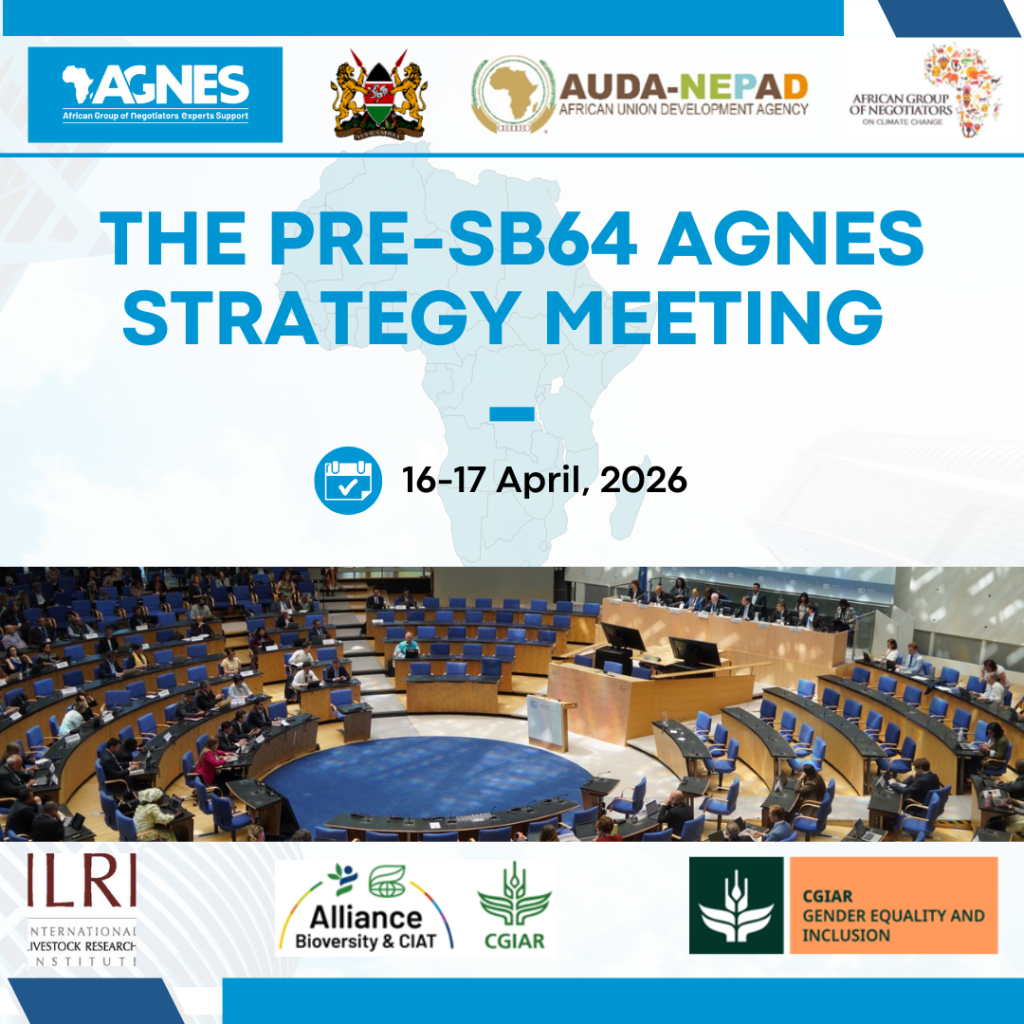
The African Group of Negotiators Experts Support (AGNES), in collaboration with the Government of Kenya, International Livestock Research Institute (ILRI), The Alliance of Bioversity International and CIAT, CGIAR Gender Equality and Inclusion, AUDA-NEPAD and the African Group of Negotiators on Climate Change (AGN) will convene the Pre-SB64 Strategy Meeting on 16th and 17th April 2026, in Nairobi, Kenya. The meeting is designed to provide a platform for African negotiators and experts to reflect on ongoing negotiations under the agriculture and gender streams, align priorities, and develop a strategic approach ahead of the 64th Sessions of the UNFCCC Subsidiary Bodies (SB 64) stipulated to take place from June 8–18, 2026, in Bonn, Germany.
Why the Meeting Matters
Every year, Parties to the United Nations Framework Convention on Climate Change (UNFCCC), together with its Kyoto Protocol and the Paris Agreement, convene to assess progress in the global response to climate change. These sessions of the Subsidiary Bodies and the Conference of the Parties provide a platform for advancing negotiations, recommending decisions, and strengthening implementation of agreed outcomes. The Pre-SB64 AGNES Strategy Meeting is therefore being convened at a critical point in the broader climate negotiation process.
Agriculture and Food Security Remain Central for Africa
Within the UNFCCC process, agriculture remains a critical priority for Africa because of its central role in economic development, contribution to GDP, employment, livelihoods, and food security. This has placed African countries at the forefront of global agriculture negotiations. These negotiations are currently guided by the Sharm el-Sheikh Joint Work on Implementation of Climate Action on Agriculture and Food Security (SSJWA), established under Decision 3/CP.27 at COP27. The SSJWA builds on the Koronivia Joint Work on Agriculture and mandates activities such as in-session workshops, the operationalization of an online portal, and annual synthesis reports on agriculture-related work.
A central feature of the SSJWA is its emphasis on implementation. For Africa, this focus is especially important given the continent’s high vulnerability to climate change impacts on agriculture and food systems. As the four-year mandate of the SSJWA approaches its conclusion at COP31, there is a growing need to reflect on lessons learned, assess progress, and define strategic directions for a post-SSJWA framework that more effectively delivers on implementation.
Just Transition and Article 6 in Focus
The meeting also comes in the context of ongoing developments under the UAE Just Transition Work Programme. Decision 3/CMA.5 requested the secretariat to organize at least two dialogues in 2026, including one prior to SB64. The SB Chairs have communicated that the fifth dialogue will focus on just transition pathways for holistic approaches to food security, including with a focus on agriculture and oceans. Parties are encouraged to make submissions on the topic through the submission portal.
At the same time, Article 6 mechanisms are becoming increasingly important in catalysing climate action on agriculture and food security. This can be achieved by creating ways for countries and stakeholders to turn climate action into economic opportunity, enabling sustainable farming and building resilient agricultural systems through global cooperation and carbon finance.
Gender as a Key Agenda Item Ahead of SB64
Gender is another major agenda item that the meeting will address. At COP30, Parties adopted the Belém Gender Action Plan (2026–2034), a nine-year framework designed to guide gender-responsive climate action at national and international levels. The plan outlines five priority areas: capacity building, knowledge and communication; gender balance, participation, and women’s leadership; coherence across UNFCCC bodies; gender-responsive implementation and means of implementation, including finance and technology; and monitoring and reporting. Through its activities and deliverables, the plan aims to drive tangible progress on gender equality across all levels of climate action.
Looking ahead to SB64, Parties are expected to further advance this agenda through discussions on strengthening the role of national gender and climate change focal points, as well as an expert dialogue on gender- and age-disaggregated data and gender analysis.
These engagements present an important opportunity for African negotiators to shape key messages, common positions, and submissions where applicable on agriculture and gender negotiations, in-session workshops, and dialogues at SB64. The meeting is also expected to enhance awareness on how to tap into ongoing Article 6 operationalization efforts to support implementation of the SSJWA and the Belém Gender Action Plan.